Iannis xenakis blogspot template
•
1970 album by Greek musique concrète pioneer Iannis Xenakis, from Nonesuch's essay-on-the-cover seriesof groundbreaking new music.
Bohor I
Concret P-H II
Diamorphoses II
Orient-Occident III
Album audio & artwork
DISCLAIMER: To the best of my knowledge, this work is out of print and not available for purchase in any format. If you are the artist and are planning a reissue, please let me know and I’ll remove it from the blog. Also please get in touch if you’ve lost your art &/or sound masters and would like to talk with me about my restoration work.
Bohor I
Concret P-H II
Diamorphoses II
Orient-Occident III
Album audio & artwork
DISCLAIMER: To the best of my knowledge, this work is out of print and not available for purchase in any format. If you are the artist and are planning a reissue, please let me know and I’ll remove it from the blog. Also please get in touch if you’ve lost your art &/or sound masters and would like to talk with me about my restoration work.
•
Compiled from diverse sources. Nornally inom do not post anything which is readily available.
Here I took a few pieces from CDs - some of them might be still in print.
The first two compostitions are - to my knowledge - not available in any form.
Please correct me when I'm wrong.
1. Pour fransk artikel Baleines (1982) for 60 strings (16.14.12.10.8) [2:49]
2. Nyuyo (Soleil Couchant) (1985) for shakuhachi, sangen and two kotos [11:26]
3. Taurhiphanie (1987-88) electronice music realised with UPIC (magnetic tape - two tracks) [11:04]
4. Gendy3 (1991) electronic music (magnetic tape - two tracks) [18:59]
5. Windungen (Retours) (1976) utgåva for 8 celli [6:20]
Cello Octet Conjunto Iberico
Elias Arizcuren, arrangement (with full permission by Xenakis)
6. Khal Perr (1983) for brass quintet + two percussionists (vibra, 2bong, 3tom, gr c) [10:34]
The efternamn Collection
John Wallace - trumpet
John Miller - trumpet
Paul Gardham - horn
Simon Gunton - trombone
Robin Haggart - tuba
Christopher Teria
•
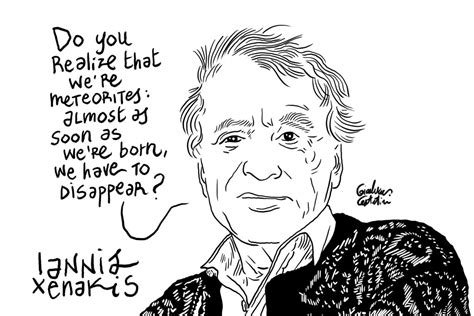
Fusing the ancient greek terms “poly”(“many”) and “topos”(“place”), Greek-French composer Iannis Xenakiscoined a neologism for his set of spatial creations that mixed together sound, light, color and architecture during live performances. The Polytopes may be considered a summa of Xenakis interests and skills, because his formation and experiences made him a prolific composer in the realm of music and in architecture.
In 1947 Xenakis joined Le Corbusier’s atelier to work on engineering design and computation. He rapidly gained more autonomy on the projects and began to design significative parts of the buildings and developing a personal research whilst inside the office. The conjunction of a specific interest for light and shadow play, the adoption of musical and mathematical motives and scores as ornamentation, as well as his approach in structural experimentation are all part of his investigation. This researches rea